


From the north · Wildlife
Argali
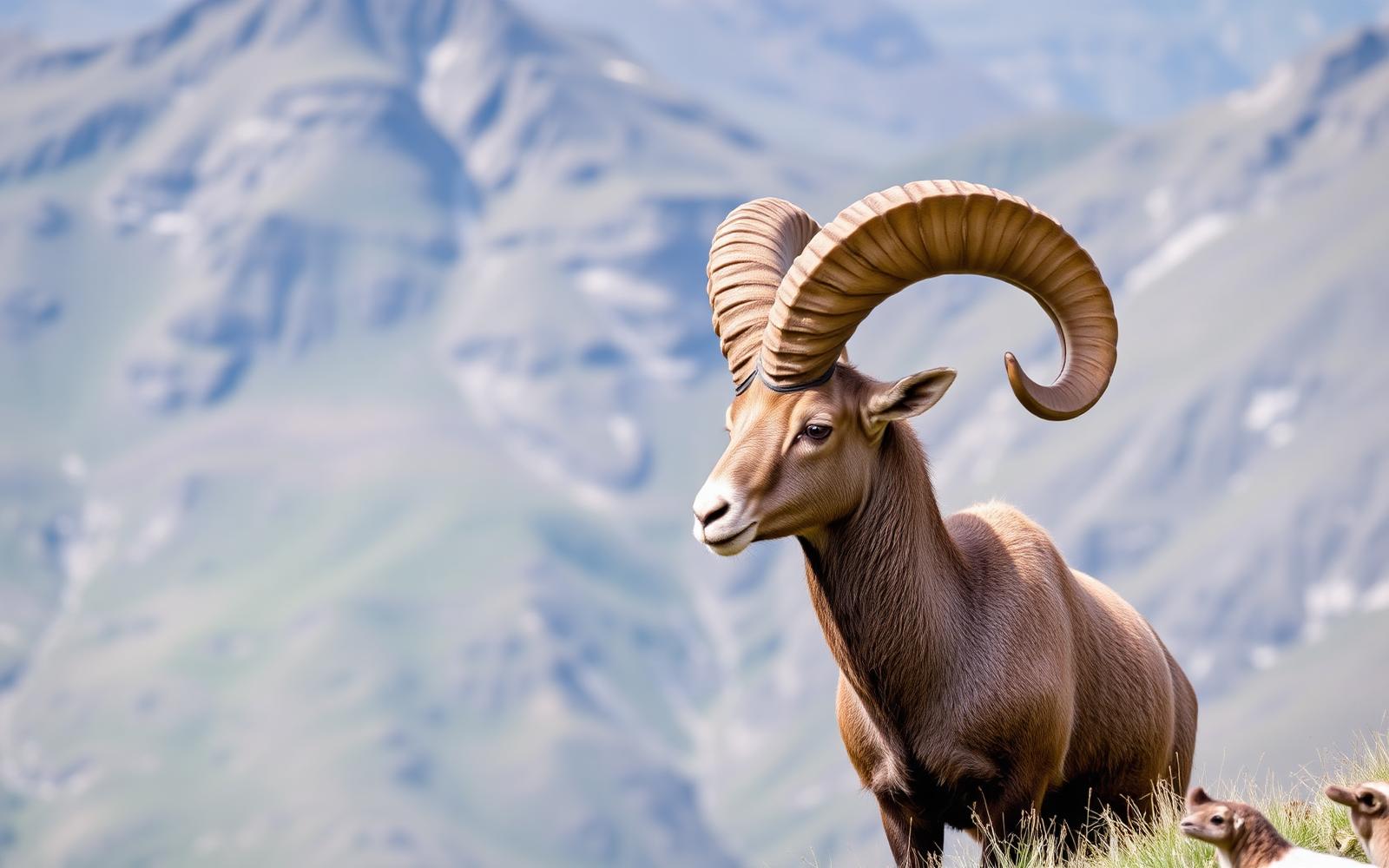
The largest wild sheep on Earth — a Mongolian mountain giant whose curled horns can weigh as much as a whole mule deer.
Ovis ammon
- Weight
- 150–400 lb (70–180 kg)
- Shoulder height
- 3.5–4.5 ft
- Horns (rams)
- 40–60 in curl, up to 60 lb pair
- Lifespan
- 10–13 yr wild
- Habitat
- Open mountain grassland, rolling alpine steppe, 1,000–5,500 m
- Group size
- Ewes + lambs in bands of 5–100; bachelor ram groups
- Lambs
- 1–2 per yr, born May–June
- Range
- Mongolia, Central Asia, Tibetan Plateau, Altai
Country to expect them
Argali prefer rolling open mountain terrain rather than the vertical cliffs favored by ibex — high grasslands, rounded ridges, and alpine benches from about 1,000 m to over 5,000 m. In Mongolia they are common in the Altai and Khangai ranges and thin across the Gobi highlands. Look for a distant band of grey-brown ungulates on a rolling ridge, and watch the ridgeline for the massive spiral horns of a mature ram.
Rams and horns
A mature Altai ram may carry horns exceeding 60 inches around the curl and weighing 60 lb as a pair — a single horn can weigh as much as a small ewe. Horns grow throughout life and are the primary sexual display; ram-on-ram head-crashing during the November–December rut is audible for miles. The largest argali subspecies (Altai argali, Ovis ammon ammon) is the biggest wild sheep on Earth.
Snow leopard's main prey
In much of their overlapping range, argali and Siberian ibex are the primary prey base for snow leopards. Where argali populations decline, snow leopards shift to livestock, and human-carnivore conflict rises. Reading a healthy argali band on a Mongolian ridge is reading habitat that can also hold snow leopard, wolf, and lammergeier.
Herder overlap
Argali share grazing with domestic sheep, goat, and yak herds across most of Mongolia. Overgrazing, disease transmission from livestock, and trophy poaching are the three main pressures on wild argali. Talk to any herder camps in the area before glassing hard — argali is a culturally significant animal and unauthorized close approach is not welcome.
Field ID vs. ibex
Argali rams: massive spiraling horns that curve outward and forward, blocky sheep-like head with a short face, tan-grey coat with a white rump patch. Ibex bucks: horns curve backward and up (not spiraled outward), longer beard, more compact body. On the same ridge, argali will be on the rolling grass; ibex will be higher on the cliff.
Male vs. female
How to tell a male from a female
Male
Rams are 30–50% heavier than ewes and carry enormous curled horns that grow year on year. Older rams show a thick neck, blocky face, and a dark 'skirt' of coarse guard hair along the shoulders and flanks. Bachelor bands of 3–15 rams roam separately from ewe herds outside the rut.
Female
Ewes are smaller and carry short, curved horns rarely more than 12–15 inches, unspiraled. Face is more slender. Ewes lead the mixed nursery herds year-round and stay with lambs and yearlings.
At a distance
Massive spiraled horns = ram. Short simple horns and a small tan lamb close by = ewe with lamb of the year. In November–December, ram bands merge with ewe herds; the largest-horned animals are the dominant breeding rams.
Field notes
- A pair of massive spiraling horns on a distant ridge is an argali ram, not an ibex — argali holds the grass, ibex holds the cliff.
- Head-crashing sounds in November–December carry miles across steppe — a rutting argali band is worth glassing from a respectful 500+ m.
- Where argali disappear from a valley, snow leopards start hitting herder livestock — the two facts are linked.