


From the north · Wildlife
Andean condor
The largest flying bird on Earth by combined weight and wingspan — a soaring scavenger you'll spot before you know it's there.
Vultur gryphus
- Wingspan
- 9.5–10.5 ft (2.9–3.2 m)
- Weight
- 17–33 lb (8–15 kg)
- Lifespan
- 50+ yr wild
- Diet
- Almost entirely carrion — guanaco, sea lion, sheep, cetacean
- Flight
- Soars 100+ mi/day with almost no flapping
- Nest
- Cliff ledge, 1 egg every 2 yr
- Fledge
- Chick dependent on adults for 12–18 months
- Range
- Andes from Venezuela to Tierra del Fuego
How to spot one
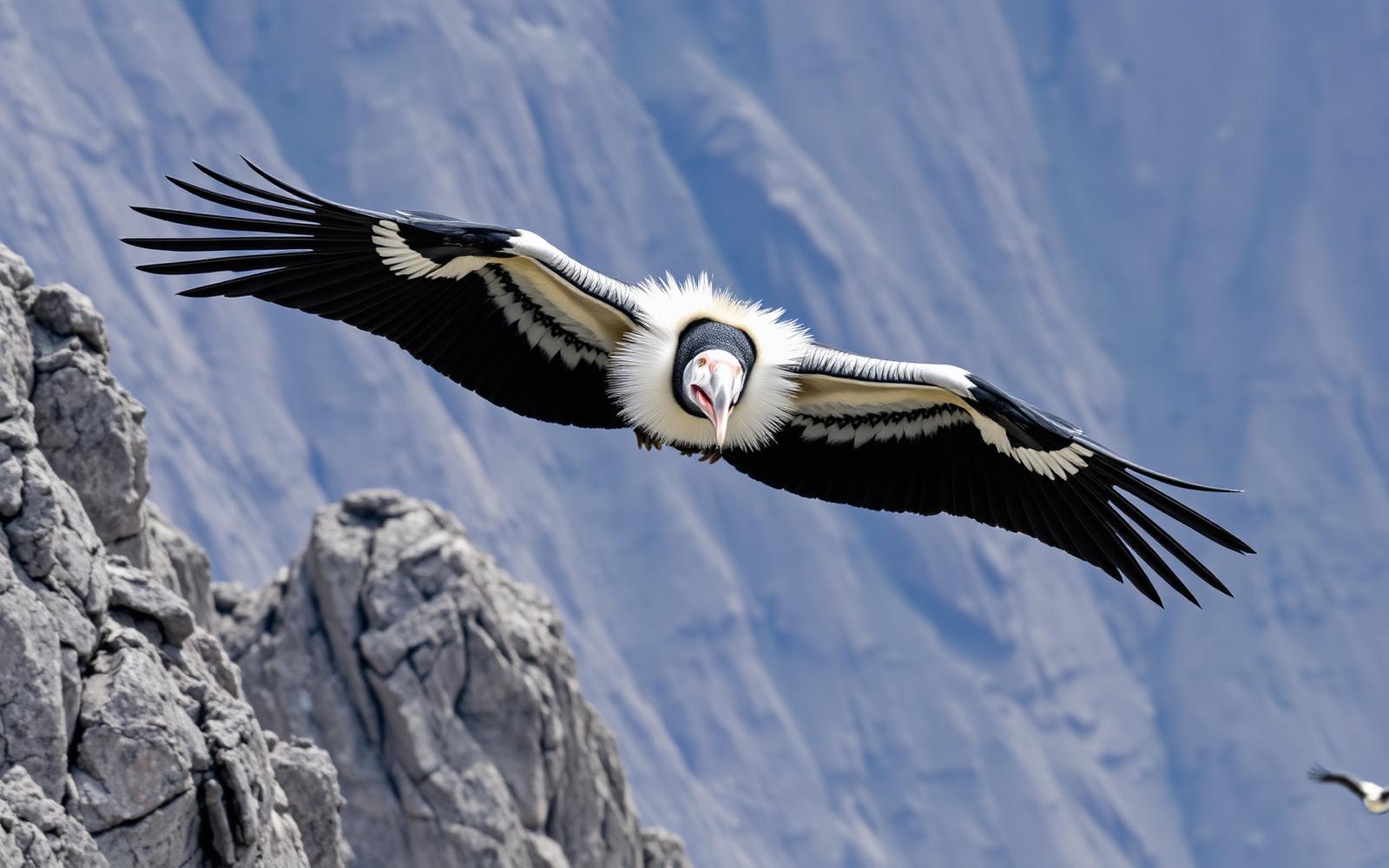
Look up. An Andean condor holds its long, plank-flat wings out at a slight dihedral with 'finger' primaries splayed at the tip, riding thermals for miles without a wingbeat. In Patagonia they are most common along the Andean spine and the escarpments above steppe valleys. Adults show the huge white neck ruff and a broad white patch across the upper wing; juveniles are all-brown with no ruff and take 6–8 years to reach adult plumage.
As a spotting tool
Two or more condors circling low, joined by caracaras and ravens, almost always mark a fresh carcass. In puma country this is a first-order signal: something died recently and something else killed it. Approach the site carefully from downwind if you must approach at all — a puma on a fresh kill will still be nearby, and the condors gather only once the cat has left.
Ecological role
As an obligate scavenger, condors clean guanaco kills, sea-lion pup carcasses on the coast, and cetacean strandings along the Chilean coast — a service that suppresses pathogen and rodent booms downstream. Lead poisoning from ingested rifle bullet fragments is the single largest modern mortality source for condor populations; non-lead ammunition matters in condor range.
Nesting and slow reproduction
Pairs bond for life and nest on huge inaccessible cliff ledges. One egg is laid every two years; the chick fledges at about 6 months but depends on the parents for a further 12–18 months. This slow reproduction is why any adult mortality event ripples through a population for decades — condors cannot 'bounce back' the way most scavengers can.
Encounters and viewing
There is no wildlife-safety issue with condors — they are pure scavengers with no interest in living prey larger than a newborn lamb. Give them space at roost cliffs and never approach a carcass they are actively working; a spooked condor loses a full crop of food and may not eat again for days.
Field notes
- Two or more condors spiralling low over one drainage almost always marks a fresh kill worth reading, not approaching.
- A plank-flat wing profile with splayed primaries is a condor; a shallow-V, tippy flight is a turkey vulture — much smaller.
- Non-lead ammunition in guanaco or livestock harvest saves condors from the biggest modern mortality source — copper bullets, not lead.