


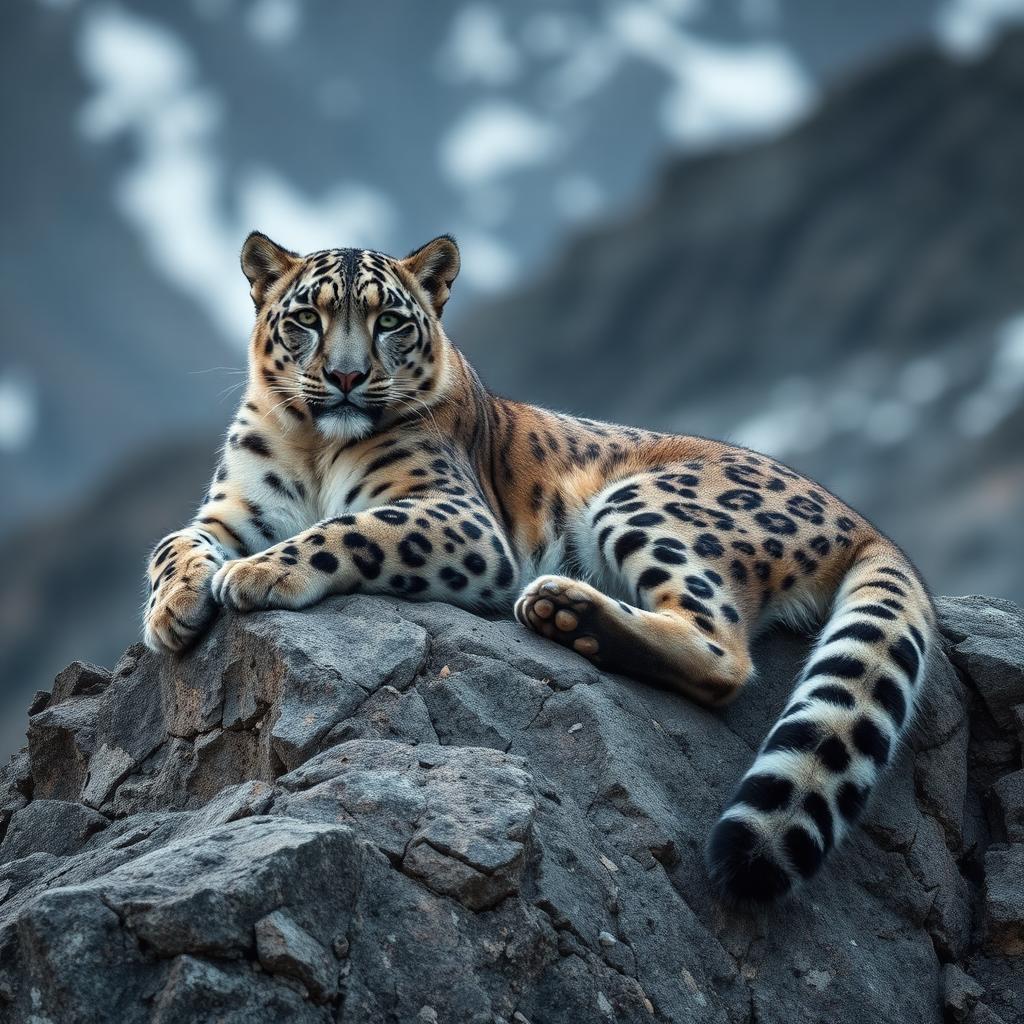
From the north · Wildlife
Snow leopard
The ghost of the Mongolian Altai — an ambush cat you will almost certainly never see, but whose sign shapes the ridgelines you cross.
Panthera uncia
- Weight
- 60–120 lb (27–54 kg)
- Length
- 6–7.5 ft including tail
- Tail
- Nearly as long as body — for balance on cliffs
- Lifespan
- 10–12 yr wild
- Territory
- 40–1,000 sq mi per adult
- Prey
- Ibex, argali, marmot, hare, occasional livestock
- Vertical leap
- 20+ ft (6 m) horizontal from standing
- Range
- Central Asian high mountains — Altai, Tien Shan, Himalaya, Hindu Kush
Where they overlap Alone Mongolia terrain
Season 5 sat in the taiga edge of northern Mongolia; snow leopards are more strongly associated with the Altai and Khangai ranges to the west, but individuals do drift into the boreal transition zone following ibex and argali. Look at any cliff, scree, or steep saddle above 2,000 m — that is snow leopard travel corridor. They avoid the dense forest itself and pick the exposed ridgeline above.
Reading the sign
You will not see the cat. You will see a scrape — a fan-shaped patch of soil kicked back with a scent-marked mound at the head — on a saddle or rock outcrop, refreshed every 2–3 weeks along a travel route. Scat is dark, twisted, packed with ibex hair, deposited on the same features. Kills are dragged to the base of a cliff or into a scree jumble and cached under rock, not under duff.
Encounter risk
Documented attacks on humans are essentially zero — the species does not include people in its prey profile. The real planning concern is a wounded or old cat driven to livestock, and Mongolian herders will sometimes retaliate against anything cat-shaped in the area. If you are moving through herder country and see fresh sign, mention it to the ger owners rather than photographing it privately.
Camp planning
Do not camp directly under a cliff face used as a travel corridor; rockfall triggered by an ibex or a stalking cat is the actual risk, not predation. Site shelter on the flat below the scree apron, not up in the boulders. Store meat inside the shelter or hung from a lone tree well away from the sleeping area — snow leopards will investigate a fresh kill scent but almost always break off contact when they detect a human.
Field notes
- A fan-shaped scrape with a scented mound at the head is the diagnostic sign — snow leopards refresh these every 2–3 weeks.
- You will not see the cat. If you do, hold still and let it leave — it is far more surprised than you are.
- Rockfall from a stalking cat or spooked ibex is the real cliff-camping risk, not predation.