


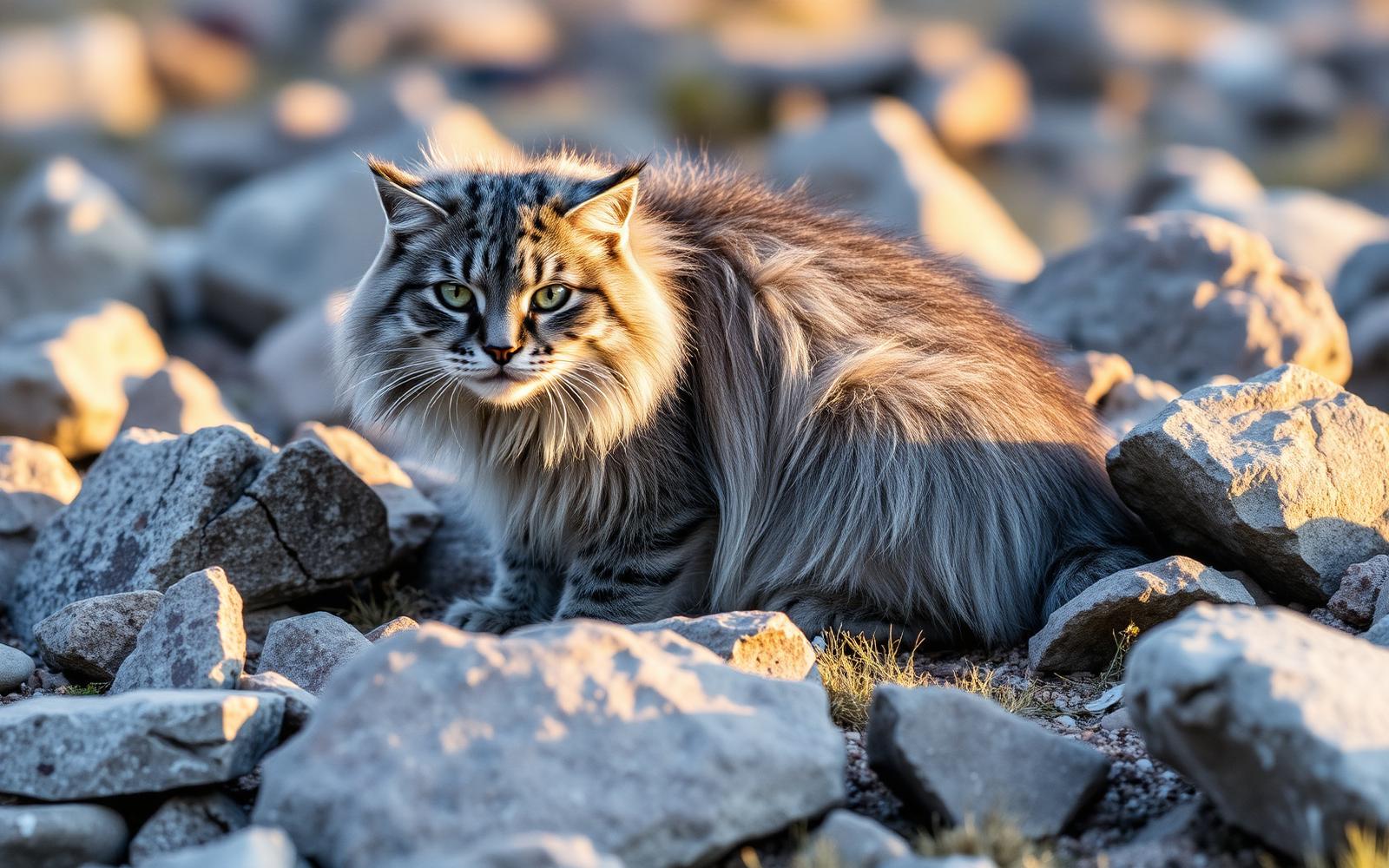
From the north · Wildlife
Pallas's cat
The grumpiest small cat in Asia — an ambush hunter the size of a house cat with the fur of a small bear.
Otocolobus manul
- Weight
- 5–12 lb (2.5–5.5 kg)
- Length
- 18–26 in body + 8–12 in tail
- Lifespan
- 5–8 yr wild
- Coat
- Densest fur of any small wild cat — insulates to −50 °C
- Diet
- Pikas, voles, ground birds, occasional hare
- Habitat
- Cold steppe, rocky outcrops, high plateau 1,000–5,000 m
- Kits
- 2–6 per yr, born April–May in rock crevice den
- Range
- Central Asian steppe — Mongolia is the stronghold
Where they live and hunt
Pallas's cats live at low density across the Mongolian cold steppe and rocky uplands, holding country most other cats can't survive. They are ambush hunters, not chasers — a Pallas's cat will sit motionless at the entrance to a pika colony or vole burrow for hours, then strike with one short pounce. The stocky body and short legs are built for hiding and pouncing, not for the sprints a serval or caracal uses on open ground.
The fur that makes them famous
Their coat is the densest of any small cat — up to 9,000 hairs per square centimetre on the belly. This is what lets them survive winter on the open Mongolian steppe at −40 °C without needing a den to hibernate in. It also gives the exaggerated 'fluffy round' silhouette that has made them viral online: the animal itself is roughly house-cat size, but the fur makes it look 30% bigger.
Encounter behavior
Extremely secretive. Almost every wild sighting is opportunistic — a cat frozen at 50 m among rocks that suddenly registers because it blinked. They rely on remaining unseen, and a spotted Pallas's cat will typically flatten and hold rather than run. If you see one, freeze, take the shot from where you stand, and do not close the distance.
Threats and status
Legally protected across most of Mongolia but pressured by feral and herder dogs, secondary poisoning from rodent-control campaigns, and steppe fragmentation. A collapse in pika density (which happens whenever the Mongolian government runs poisoning programs) directly collapses Pallas's cat reproduction the following season.
Field ID
Small, stocky cat with a flat wide face, low set round ears (unusual — most cats' ears are set higher), yellow eyes with round pupils (rather than the vertical slits of most cats), and a heavily furred tail with dark rings. On the steppe, no other wild cat looks like this — the flat face and round low ears are diagnostic.
Field notes
- A small round cat frozen against grey rock is almost never a house cat gone wild — check the flat face and low round ears for Pallas's cat ID.
- Rodent-poisoning campaigns crash pika populations, and Pallas's cats crash the following season — connect the two if a valley suddenly has no cats.
- A Pallas's cat that flattens rather than runs when spotted is not injured — it is trusting its camouflage. Freeze and back off.