


From the north · Wildlife
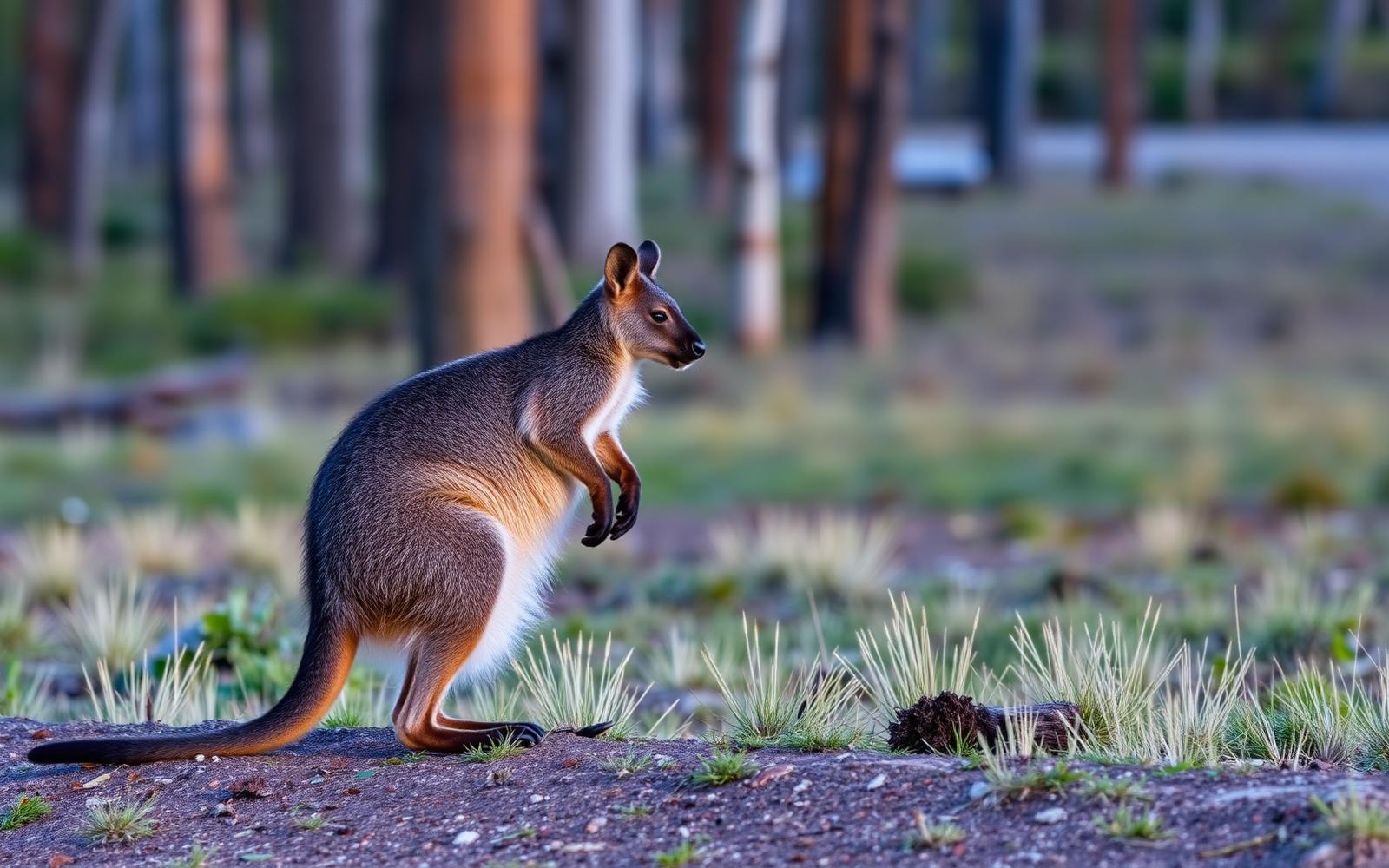
Bennett's wallaby
Tasmania's mid-sized macropod — the abundant grazing marsupial that lives at almost every campsite and every road edge on the island.
Notamacropus rufogriseus
- Weight
- 30–60 lb (14–27 kg)
- Length
- 3 ft body + 2–2.5 ft tail
- Lifespan
- 9–15 yr wild
- Habitat
- Eucalypt forest edge, button-grass moor, farmland fringe, sub-alpine
- Diet
- Grass, sedge, forbs, browse — mostly at dusk and dawn
- Group size
- Solitary, but many congregate on preferred grazing
- Joey
- One at a time, pouched ~9 months, then at-heel to ~18 months
- Range
- Tasmania (subspecies rufogriseus), coastal SE Australia
The most common macropod in Tasmania
Bennett's wallaby (the Tasmanian subspecies of the red-necked wallaby) is by far the most abundant medium-sized marsupial on the island — you will see them at nearly every campsite, along nearly every road at dusk, and along nearly every open forest edge. They are the primary prey base for large birds of prey (wedge-tailed eagle), for feral cats on joeys, and for scavengers like the Tasmanian devil, quoll, and forest raven cleaning roadkill.
Camp behavior and habituation
In heavily used camping areas, Bennett's wallabies rapidly lose their fear of people and will approach for handouts, chew boots, and drag food bags away. Do not hand-feed — habituated wallabies get hit by cars, spread aggression among their own group, and pass zoonotic disease. Store food hard-cased or hung, close tent zippers, and don't leave anything with salt-sweat outside overnight.
Reproduction
Bennett's wallabies use embryonic diapause — a fertilised embryo can pause development in the uterus until the pouched joey emerges. In good conditions a female can have one joey in the pouch, another at-heel, and a paused embryo waiting to implant, all at the same time. This is why wallaby populations can rebound quickly after fire or drought once conditions improve.
As food and hazard
Where legal, wallaby is lean, dark, gamey meat and a subsistence food across rural Tasmania. On roads, wallabies are the number-one wildlife-vehicle strike animal on the island — they emerge at dusk and dawn, freeze in headlights, and often bolt into the road rather than off it. Drive slowly through dusk in wallaby country; hitting one at speed is dangerous to both the driver and the animal.
Devil facial tumour disease link
Wallaby carcasses are a key food source for Tasmanian devils and quolls, and shared feeding at carcasses is one mechanism for spreading devil facial tumour disease (DFTD). Where possible, drag any road-killed wallaby well off the shoulder to reduce vehicle-strike mortality on devils cleaning up the carcass at night.
Male vs. female
How to tell a male from a female
Male
Bucks are noticeably larger and heavier than does, with more muscular forearms and a thicker neck. Older bucks show a rusty-red patch on the shoulders and nape (the 'red-necked' feature) that is much more pronounced than in does.
Female
Does are smaller and slimmer, usually with a joey visible in the pouch or trailing at heel. In cool weather the joey's tail and feet may be sticking out of the pouch as it grows too large to fit fully inside.
At a distance
A pouched joey or an at-heel small wallaby means the adult is a doe. A solitary large-framed animal with a strong red shoulder patch is usually a mature buck.
Field notes
- A wallaby approaching your camp is a habituation problem — do not feed, and hard-case food from day one.
- Dusk on rural Tasmanian roads is peak wallaby-strike season; slow down through forest edges and moor country.
- Drag any road-killed wallaby well off the shoulder — it saves devil and quoll lives while they clean it up at night.