


Resources
Outdoor Skills
106 bite-size wilderness tutorials — the kind of things you want in your head before you need them. Each skill is one screen: three to six steps, a tip, and any real warnings.
12 skills
Fire
5 minLight a one-match fire
A single match is enough when the platform is built before the match comes out.
- Clear a dry patch of ground down to mineral soil or lay a bark platform.
- Prepare three graded piles: fine tinder (dry grass, birch bark, fatwood shavings), pencil-thick kindling, and thumb-thick sticks.
- Build a small teepee of the finest tinder with a pencil-lead-thin gap to insert the match.
- Strike the match toward the ground, cup it, and touch it to the lowest point of the tinder.
- Feed pencil-thick kindling on as the flame climbs; only add thumb-thick sticks once flames stand on their own.
Tip: Split a wet stick — the inside is almost always dry. Shave that inside into a pile of curls.
Trailagain — The One Match Fire

Fire
4 minCarve a feather stick
A feather stick turns one dry piece of wood into a fire's worth of tinder.
- Pick a dry, straight-grained stick the diameter of your thumb. Split it if the outside is damp.
- Brace one end on a solid surface at a shallow angle away from your body.
- Slice long, thin curls with the knife, stopping short so the shavings stay attached.
- Rotate the stick a quarter turn and repeat until the top third is a bloom of curls.
Tip: Sharper knife, thinner curls. If the shavings snap off, ease the angle and slow down.
Far North Bushcraft — Feather Stick Tips

Fire
20 minMake char cloth for flint and steel
Char cloth catches a spark instantly and buys you a full ember to blow into flame.
- Cut 100% cotton (old jeans, canvas) into 2-inch squares.
- Pack loosely into a small tin with a single pin-hole punched in the lid.
- Set the tin on coals — smoke will jet from the hole.
- When the smoke stops, pull the tin off and plug the hole with a twig; let it cool sealed.
- Cloth should be uniformly black, still flexible, and tear cleanly.
Warning: Opening the tin while hot lets oxygen in and burns your char to ash.
PaleoHikerMD — Making a Better Char Cloth

Fire
15 minBow drill: what actually matters
Friction fire fails on details. Get these right before the arm burns out.
- Match soft, dry woods for spindle and hearth (cedar, cottonwood root, willow). Don't mix hard and soft.
- Spindle: thumb-thick, 8 inches, blunt on bottom (friction end), pointed on top (bearing end).
- Cut a pie-slice notch in the hearth board reaching to the center of the burn socket, so dust can pile up.
- Bow: shoulder-wide, slight curve, loose cord that tightens once the spindle is loaded.
- Long, full strokes; downward pressure only increases once black dust and smoke are steady.
- Tap the ember out of the notch onto bark, transfer to a tinder bundle, and blow steady from below.
Tip: If it squeals, it's polished — rough up the socket and hearth with sand.
NatureMentor — Bow Drill Fire

Fire
5 minFind dry tinder in wet woods
Standing dead wood and inner bark stay dry through days of rain.
- Skip anything on the ground — it's wicking water.
- Look for standing dead branches still attached to trees; snap them for a dry, sharp crack.
- Peel birch bark from dead trees only; it lights wet.
- Pull inner bark from dead cedar or juniper and shred between the palms into a fluff.
- Look under conifer skirts for dry needles and pitch-soaked wood (fatwood) at stump bases.
Wilderness Strong — Fire in Wet Weather
Fire
10 minStart a fire with flint and steel
A high-carbon steel and a hard rock throw sparks that only catch on truly dry, charred, or highly fibrous tinder.
- Prep a tinder nest of fine, bone-dry material and a small pinch of char cloth or true punkwood in the center.
- Hold the flint (or quartz/chert) in your off hand with a sharp edge angled up, char resting on top and pinched under your thumb.
- Strike the steel down and across the edge with a firm glancing blow — you want shaved sparks, not chips of rock.
- When a spark lands in the char and glows, transfer the char into the tinder nest and fold it closed.
- Cup the nest and blow steadily from below until it flames, then set it under a prepared kindling teepee.
Tip: If sparks skip past the char, the angle is wrong. Aim the sparks straight down onto the char rather than out into the air.
Fire
5 minHarvest and use birch bark tinder
Paper birch bark contains oils that light in rain and snow — one of the most reliable natural tinders in the northern woods.
- Take only loose, curling outer bark from live trees or strip freely from downed birch — never cut the inner bark of a healthy tree.
- Shred a small handful into thin ribbons and tease the edges until they look like feathers.
- Build a small platform of dry twigs, then set the shredded bark on top so air can flow underneath.
- Light from below with a match, spark, or ember; the oils will sustain flame for 30–60 seconds.
- Feed pencil-thick kindling the moment flames catch, and add heavier wood only when the fire stands on its own.
Warning: Girdling a live birch — cutting a full ring of bark around the trunk — will kill the tree. Take only loose outer layers.
Fire
15 minBank a fire to keep coals overnight
A properly banked fire holds live coals until morning, saving you a cold restart at dawn.
- Let the fire burn down until you have a solid bed of glowing coals — no active flame.
- Rake the coals into a compact pile in the center of the fire pit.
- Cover the coals with a 2–3 inch layer of dry ash, then a thin layer of dry soil or fine sand.
- Leave one small vent hole at the top so air can trickle in without the coals burning through the cover.
- In the morning, brush back the cover, add fine tinder to the exposed coals, and blow gently to raise a flame.
Tip: Hardwood coals bank far better than softwood. Save your best coals from oak, maple, or ash for the overnight pile.
Fire
20 minBuild a long-log fire for cold nights
Two parallel logs and a reflector turn a small fire into a heater that runs for hours with minimal tending.
- Lay two dry logs (wrist to arm-thick, 4–6 feet long) parallel on the ground about a hand-span apart.
- Fill the gap between them with a full-length bed of tinder, then kindling, then thumb-thick sticks.
- Light along the length so the whole channel catches at once; the two logs will slowly burn inward toward each other.
- Build a low reflector wall of green logs or stacked stones on the far side to bounce heat back to your shelter.
- As the top logs burn down, roll fresh logs onto the bed rather than breaking down and rebuilding the fire.
Warning: Never sleep with a fire close enough to catch bedding. A minimum of one body-length between fire and sleeping surface is a good rule.
Fire
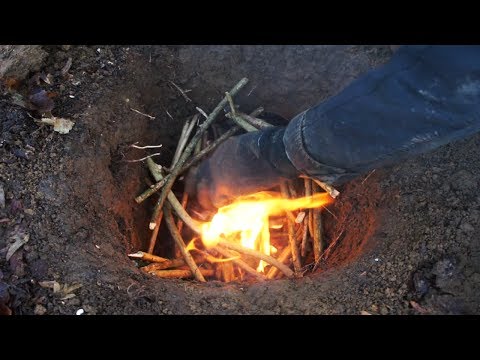
25 minDig a Dakota fire hole
A Dakota fire hole burns hot, hidden, and windproof by drawing air through an underground tunnel.
- Dig a vertical pit about 2 feet deep and 1 foot wide where you want the fire.
- Dig a second, smaller hole the same depth roughly 1 foot away, connected to the first by a horizontal tunnel at the bottom.
- Pile kindling in the main pit and light it; the second hole pulls air in and feeds the flames from below.
- Cook on a small grate or lay sticks across the main pit.
- When finished, fill both holes with the excavated soil and tamp down.
Tip: Angle the connecting tunnel slightly upward toward the fire pit so falling embers don't roll into the air intake.
TA Outdoors — The Dakota Fire Hole

Fire
3 minStart a fire with a battery and steel wool
A 9-volt battery and a puff of steel wool make a sparkless, windproof fire starter that works in the rain.
- Pull a small wad of fine steel wool (grade 000 or 0000) into a loose, airy ball about the size of a walnut.
- Set the wool on a bed of dry tinder, birch bark, or fine grass.
- Touch both battery terminals to the wool at the same time.
- The wool will glow and burn from the inside out — blow gently to spread the heat into the tinder.
- Feed kindling as soon as flames appear.
Warning: Keep the battery and steel wool separated in your pack. Accidental contact can start a fire inside your bag.
The Outsider — Fire with Steel Wool & 9V Battery
Fire
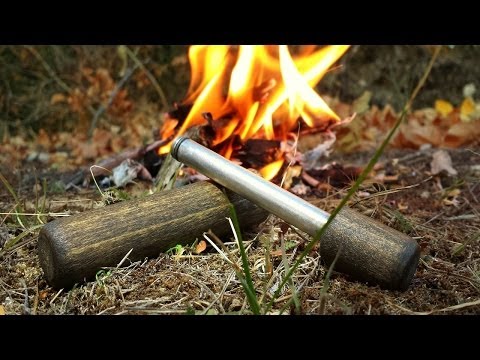
10 minUse a fire piston
A fire piston ignites tinder by compressing air so fast that the heat of compression lights it.
- Place a tiny piece of char cloth, true punkwood, or very fine tinder into the notch at the end of the piston rod.
- Drop the rod into the cylinder so the tinder sits just inside the mouth.
- Hold the cylinder steady and slam the rod down in one fast, firm stroke.
- Pull the rod out quickly; the char should be glowing red.
- Transfer the ember into a tinder nest and blow it into flame.
Tip: A dry, well-polished bore and a tight leather gasket are what make compression work. If it gets sluggish, rub a little beeswax or fat on the gasket.
John McCann — How To Use A Fire Piston
Educational reference only. Wilderness conditions change fast — practice in low-stakes settings, take a certified wilderness first-aid course, and confirm regional regulations (fire, fishing, foraging, snaring) before you rely on any of these skills in the field.