

Best overall
Garberg— Morakniv
Best for: One-knife northern woodcraft kit
Full-tang stainless Scandi, standardized parts, will outlive most of its owners.
Verified product record


Buying guide
A fixed-blade bushcraft knife is a full-tang or robust stick-tang cutting tool between roughly 3.5 and 5.5 inches, purpose-built for wood processing, food prep, and finishing tasks a folder can't handle safely.
By Wild10 Editors · Fieldcraft desk · Updated 7/16/2026
A fixed-blade bushcraft knife is a full-tang or robust stick-tang cutting tool between roughly 3.5 and 5.5 inches, purpose-built for wood processing, food prep, and finishing tasks a folder can't handle safely.
Woodcrafters, campers, hunters, canoeists, and anyone whose trip depends on reliably starting a fire, prepping food, and shaping wood in the field.
Choose high-carbon (1095, O1) for easy field sharpening; stainless (12C27, S30V) for wet coastal or brackish country.
Scandi grinds carve wood cleanly; convex grinds are more durable when batoning; flat grinds are the food-prep compromise.
Full-tang for baton or pry loads; stick-tang saves weight in a dedicated carver. Handles should fill the hand without hotspots.
Kydex or dangler leather with positive retention. Firm belt carry that doesn't rattle at your hip.
| Trip profile | Recommended blade | Length | Steel |
|---|---|---|---|
| Northern woodcraft, one-blade kit | Scandi full-tang | 4–5 in | High-carbon 1095/O1 |
| Wet coastal / rainforest | Scandi stainless | 4–4.5 in | Sandvik 12C27 or S30V |
| Hunting + camp combo | Flat-ground drop point | 3.75–4.5 in | S30V or 3V |
| No axe carried (heavy batoning) | Convex full-tang | 5–5.5 in | A2 or 3V |
| Steel | Edge holding | Sharpen in field | Corrosion | Cold brittleness |
|---|---|---|---|---|
| 1095 carbon | Good | Easy | Rusts fast | Stable |
| O1 carbon | Very good | Easy | Rusts fast | Stable |
| A2 tool steel | Great | Moderate | Rusts | Stable |
| Sandvik 12C27 | Good | Easy | Stainless | Stable |
| S30V / S35VN | Great | Hard | Stainless | Stable |
| CPM 3V | Excellent | Moderate | Semi-stainless | Excellent |
Below ~-20 °C, many carbon steels remain reliable but epoxy-set micarta and G10 outlast wood scales. In salt spray, prioritize stainless steel and a stainless pin/pommel.
Blade 4–5 in is the honest one-blade default. Under 3.75 in belongs in a two-knife pair with a chopper. Over 5.5 in starts substituting for a hatchet.
Best overall
Best for: One-knife northern woodcraft kit
Full-tang stainless Scandi, standardized parts, will outlive most of its owners.
Verified product record

Best value
Best for: First serious bushcraft knife under $80
Hybrid Scandi/secondary bevel, stainless, sheath included.
Verified product record
Best premium
Best for: All-day carving with abuse tolerance
Convex A2 in a hand-filling handle. Rare that any single knife rewards refinement this much.
Research pending — no verified product page yet
Best for beginners
Best for: Learning wood carving without breaking a bank
Impossible to outgrow, easy to sharpen, and safe to learn on.
Research pending — no verified product page yet
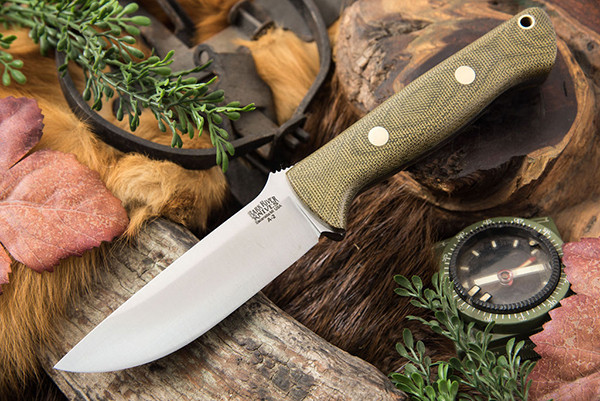
Best if you skip the axe
Best for: Solo trips where one blade must chop and carve
Convex 3V, thick spine, forward balance for splitting kindling.
Verified product record
Best delicate carver
Best for: Traditional woodwork and detail carving
Stick-tang Finnish puukko — unmatched for feather sticks and fine notches.
Research pending — no verified product page yet
| Role | Product | Brand | Price (USD) | Weight | Made in |
|---|---|---|---|---|---|
| Best overall | Garberg | Morakniv | $269 | — | Sweden |
| Best value | Kansbol | Morakniv | $269 | — | Sweden |
| Best if you skip the axe | Bark River Bravo 1 | — | — | — | — |
Every pick has been carried by at least one Wild10 contributor for a full season, or is graded 'specification researched' with the label shown on the product page. We do not label a knife 'field tested' unless a named contributor tested it. Prices are verified against retailer offers weekly.