


Resources
Outdoor Skills
106 bite-size wilderness tutorials — the kind of things you want in your head before you need them. Each skill is one screen: three to six steps, a tip, and any real warnings.
7 skills

Field Skills
45 minFind and process wild clay
Clay is everywhere along streambanks and cutbanks — you just have to test for it.
- Look at cutbanks, riverbends, and exposed subsoil below the leaf layer.
- Grab a handful, wet it, and roll a snake the thickness of a pencil.
- If it bends around your finger without cracking, it's usable clay.
- Slake: break it up in water, stir, let sit. Sand and gravel sink, clay stays suspended.
- Pour off the milky water into a cloth-lined pit; let it drain until leather-hard, then wedge (knead) to remove air.
Tip: Test-fire a small pinch pot in a hot fire. If it survives without exploding, the clay's clean enough to use.
Andy Ward — Wild Clay for Beginners
Field Skills
30 minLeave no trace of a fire
A properly disposed fire leaves the site indistinguishable from surrounding ground — good practice everywhere, not just in wilderness areas.
- Burn all wood to fine ash — no charred chunks remaining.
- Drown the ashes with water, stir, and drown again. Repeat until you can put your bare hand on the ash without any warmth.
- Scatter the cold wet ashes broadly outside the camp area — never in one heap.
- Return any rocks used for a ring to where you found them, dirty side down.
- Sweep the area with a branch to disguise scorch marks and lift compressed vegetation.
Warning: The single most common cause of wildfire is an incompletely drowned fire. If you can feel any warmth in the ashes, it's not out.
Field Skills
20 minCache food safely in bear country
In bear country, every scented item — food, toothpaste, sunscreen — must be secured away from your sleeping area.
- Use a certified bear canister where required, or an Ursack tied to a tree trunk.
- For hangs, find a branch at least 15 feet up and 4 feet out from the trunk, with the food bag suspended 5 feet below the branch.
- Use the counterbalance or PCT hang method so a bear cannot swat the bag down by yanking a rope.
- Store food, cooking gear, and any scented items at least 100 yards downwind from your tent.
- Never keep food, snack wrappers, or scented items in your tent, even in a pack.
Warning: A bear that gets a human food reward once will return, and that bear often ends up destroyed by wildlife officers. Bad food storage kills bears.
Field Skills
2 minEstimate remaining daylight with your hand
The width of your fingers between the sun and the horizon gives a surprisingly accurate estimate of hours until sunset.
- Extend your arm fully, palm facing you, fingers together and horizontal.
- Align the bottom edge of your little finger with the horizon.
- Count the fingers stacked between the horizon and the sun — each finger is approximately 15 minutes of daylight.
- If the sun sits higher than one hand, stack your other hand on top and continue counting.
- Round down to give yourself a margin for camp setup before dark.
Tip: Start setting up camp when you have two hands (about two hours) of daylight left. Rushing at dusk is when cuts, burns, and lost gear happen.
Field Skills
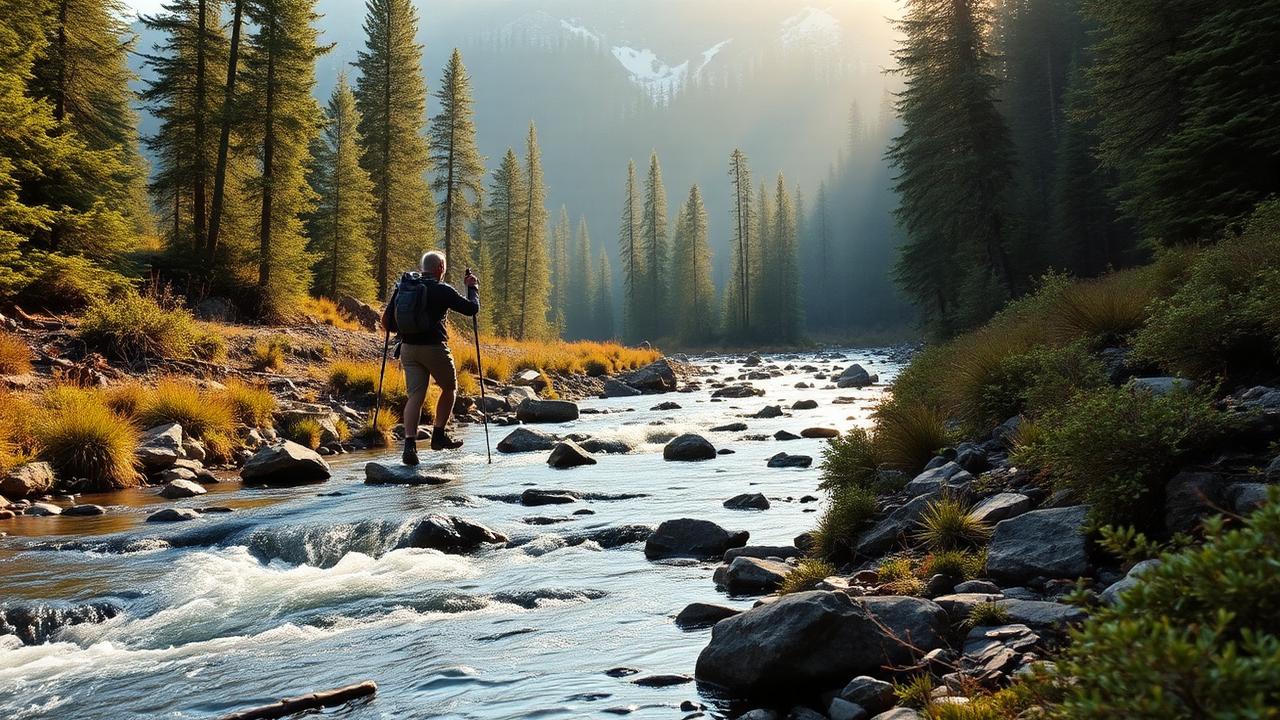
15 minCross a swift stream safely
Moving water is one of the leading causes of backcountry deaths. Cross rarely, carefully, and only when you have to.
- Scout upstream and downstream for a wider, shallower spot; narrow spots are deep and fast.
- Unclip your pack's hip belt and sternum strap so you can shed it fast if you fall.
- Face upstream, use a stout pole for a third point of contact, and shuffle sideways rather than lifting your feet high.
- Cross at an angle, moving downstream at about 45°, so the current helps push you across.
- If you slip, go on your back with feet pointed downstream and use them to fend off rocks until you can swim to shore.
Warning: Water above the knees moving faster than a walking pace can knock down an adult. If the crossing looks marginal, wait for morning — mountain streams often drop overnight.
Field Skills
5 minEstimate distance in the field
Quick tricks give you distance estimates good enough for route planning without a rangefinder.
- Object size at arm's length: a person clearly recognizable but small is about 100 yards; head just a dot is about 200 yards; body only visible is about 300 yards.
- Sound and light: count the seconds between a lightning flash and its thunder — every 5 seconds is roughly one mile.
- Pace count: know your average pace over 100 meters (usually 60–70 double-paces for adults) and count as you walk.
- Terrain multiplier: rough or steep terrain roughly doubles the time — not the distance — you'll need to cover it.
- Verify with a map whenever you can. Estimation compounds error over long distances.
Tip: Practice on a known distance at home. Most people badly underestimate how far a mile really looks across open country.
Field Skills
10 minRepair broken glasses in the field
A broken pair of glasses in the backcountry becomes a safety problem fast. A few field fixes get you home.
- Broken nose bridge: wrap tightly with a strip of cloth tape or duct tape, splinted with a matchstick or twig for rigidity.
- Popped-out lens: warm the frame slightly by a fire, gently press the lens back in place, cool it, and check by lightly tapping the frame.
- Broken temple arm: splint with a stick or bent hairpin, tape or lash to remaining arm.
- Missing screw: replace temporarily with a small wire from a twist tie or a very thin sliver of wood pushed through the hinge hole.
- Cracked lens: cover the crack with clear tape on both sides to keep it holding shape until you can replace it.
Tip: Carry a spare pair of glasses (or your last prescription) in your pack for any multi-day trip. Duct tape is a fix; a spare is a solution.
Educational reference only. Wilderness conditions change fast — practice in low-stakes settings, take a certified wilderness first-aid course, and confirm regional regulations (fire, fishing, foraging, snaring) before you rely on any of these skills in the field.