
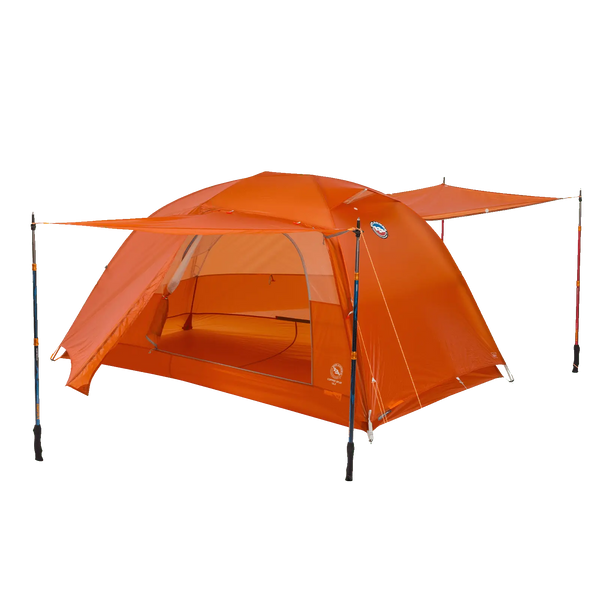
Best overall backpacking tent
Copper Spur HV UL2— Big Agnes
Best for: Most solo and couples backpacking trips
Semi-freestanding 2P with real vestibules and a proven weather record.
Verified product record


Buying guide
Tents, tarps, and hammock shelters are portable shelter systems categorised by season rating (3-season vs 4-season), wall construction (single-wall vs double-wall), and pole/pitch system.
By Wild10 Editors · Fieldcraft desk · Updated 7/16/2026
Tents, tarps, and hammock shelters are portable shelter systems categorised by season rating (3-season vs 4-season), wall construction (single-wall vs double-wall), and pole/pitch system.
Backpackers, canoeists, family campers, and winter travellers who need a repeatable shelter for one to four people.
3-season for spring–fall; 4-season for winter storms and snow load; 5-season for expedition.
Double-wall: cooler, drier in condensation. Single-wall: lighter, faster to pitch.
Bathtub floors 6+ inches high prevent splash-back in heavy rain.
Enough to store a pack per person, plus wet boots.
| Use | Shelter type | Weight target | Setup |
|---|---|---|---|
| Fast & light backpacking | Silnylon tarp + bivy | < 1.5 lb | Trekking poles |
| Solo 3-season | Semi-freestanding tent | 2–3 lb | 2 poles |
| Couple's 3-season | Freestanding 2P tent | 3–4 lb | 2 poles |
| 4-season expedition | Double-wall 4-season tent | 5–8 lb | 3–4 poles |
| Fabric | Weight | Waterproof | Stretch when wet | Cost |
|---|---|---|---|---|
| Silnylon (30D) | Light | 1500 mm+ | Yes | $$ |
| Silpoly | Light | 1500 mm+ | Less | $$ |
| Dyneema Composite Fabric | Ultralight | Excellent | None | $$$$ |
| 68D polyester (family tent) | Heavy | 1500 mm | Less | $ |
In sustained rain, prefer silpoly over silnylon — silnylon sags. In deep snow, prioritize steep walls and snow flaps. In desert, prioritize ventilation over insulation.
Rated capacity is optimistic — subtract one person for gear. Vestibule area matters more than nominal floor size on multi-day trips.
Best overall backpacking tent
Best for: Most solo and couples backpacking trips
Semi-freestanding 2P with real vestibules and a proven weather record.
Verified product record
Best value
Best for: First backpacking tent under $300
Freestanding 2P with steel-weight durability.
Research pending — no verified product page yet
Best premium expedition tent
Best for: 4-season wind-loaded terrain
Bombproof geometry, snow flaps, and long-term reliability.
Research pending — no verified product page yet
Best for beginners
Best for: Family and car-camping baseline
Standing height, generous porch, easy setup.
Research pending — no verified product page yet
Best tarp for bushcraft
Best for: Fire-front shelter camps
Rugged 3.6 × 3.6 m silnylon tarp that pitches a dozen ways.
Research pending — no verified product page yet
Best ultralight solo tent
Best for: Weight-first solo trips
Dyneema single-wall, no zippers to fail.
Research pending — no verified product page yet
| Role | Product | Brand | Price (USD) | Weight | Made in |
|---|---|---|---|---|---|
| Best overall backpacking tent | Copper Spur HV UL2 | Big Agnes | $599 | — | United States |
Weather ratings reflect our contributors' field observations plus manufacturer specs. Ultralight tents are rated against pitched-in-storm performance, not fair-weather weight.